
Introduction
If you are buying or selling a home in Dubai in 2026, one question sits at the top of your mind. What will the commission for real estate agent services cost me?

It is a completely fair question. You want to know the fees upfront and feel confident you are not overpaying. But the truth is, many clients find commission structures confusing. And with that confusion comes a real fear of hidden fees or getting caught in a bad deal. You might even wonder what a dubai realtor actually does to earn their pay.
Here is the good news. Dubai has a well regulated market. The Real Estate Regulatory Agency (RERA) sets clear rules for how property transactions work. For example, Law No. 9 of 2009 and Law No. 13 of 2008 spelled out the rules for the property register, which helps protect buyers and keep the market fair. Understanding these rules protects your money and your peace of mind.
This guide explains everything you need to know. We break down how the commission of a real estate agent works in Dubai. We also cover exactly what the law says, so you can negotiate fairly and with confidence. If you are comparing agencies, reading a detailed review like our FAM Properties Dubai review can help you see how different firms handle their fees. For the latest numbers and standard rates, check out our complete breakdown of real estate commission in Dubai 2026.
By the end, you will know exactly what to expect. No guesswork. No stress. Just clear, smart knowledge to help you make the best decision for your property goals.

What Are Real Estate Commissions in Dubai?
Let’s start with the simple definition. A commission for a real estate agent is a fee you pay the agent for a successful job. Think of it as a success fee. The agent only gets paid when they connect a buyer with a seller or help someone sign a lease. No sale means no commission.
So what does a dubai realtor actually do to earn this fee? A good agent markets your property, finds qualified buyers, handles negotiations, manages paperwork, and guides you through the entire transaction. You can learn more about their role in our complete guide to what real estate agents do.
Now, who sets the rules? The Real Estate Regulatory Agency (RERA) is the government body that oversees the whole market. RERA makes sure agents follow the law, disclose their fees upfront, and never hide extra charges. Laws like Dubai Law No. 13 of 2008 and its amendment in Dubai Law No. 9 of 2009 created the property register system that keeps transactions transparent and protects both buyers and sellers.
This legal framework matters because it stops shady behavior. Agents must tell you their commission rate before you sign any agreement. They cannot add surprise fees later.
What about the actual numbers? In 2026, the typical commission of a real estate agent for a residential property sale in Dubai falls between 2% and 5% of the purchase price. For example, on a AED 1 million property, you might pay between AED 20,000 and AED 50,000 in commission. The exact percentage depends on the property type, the agent’s experience, and how hard you negotiate.
For the most current rates and tips on getting a fair deal, check our full breakdown of real estate commission in Dubai 2026. Knowing these numbers before you start gives you a real advantage at the negotiation table.
How Are Commissions Calculated?
You might wonder how that 2% to 5% figure actually turns into cash. It’s not magic. It follows clear rules. Let’s break down the two main ways commissions get calculated.
Percentage based is the standard. Most agents charge a percentage of the final sale price.
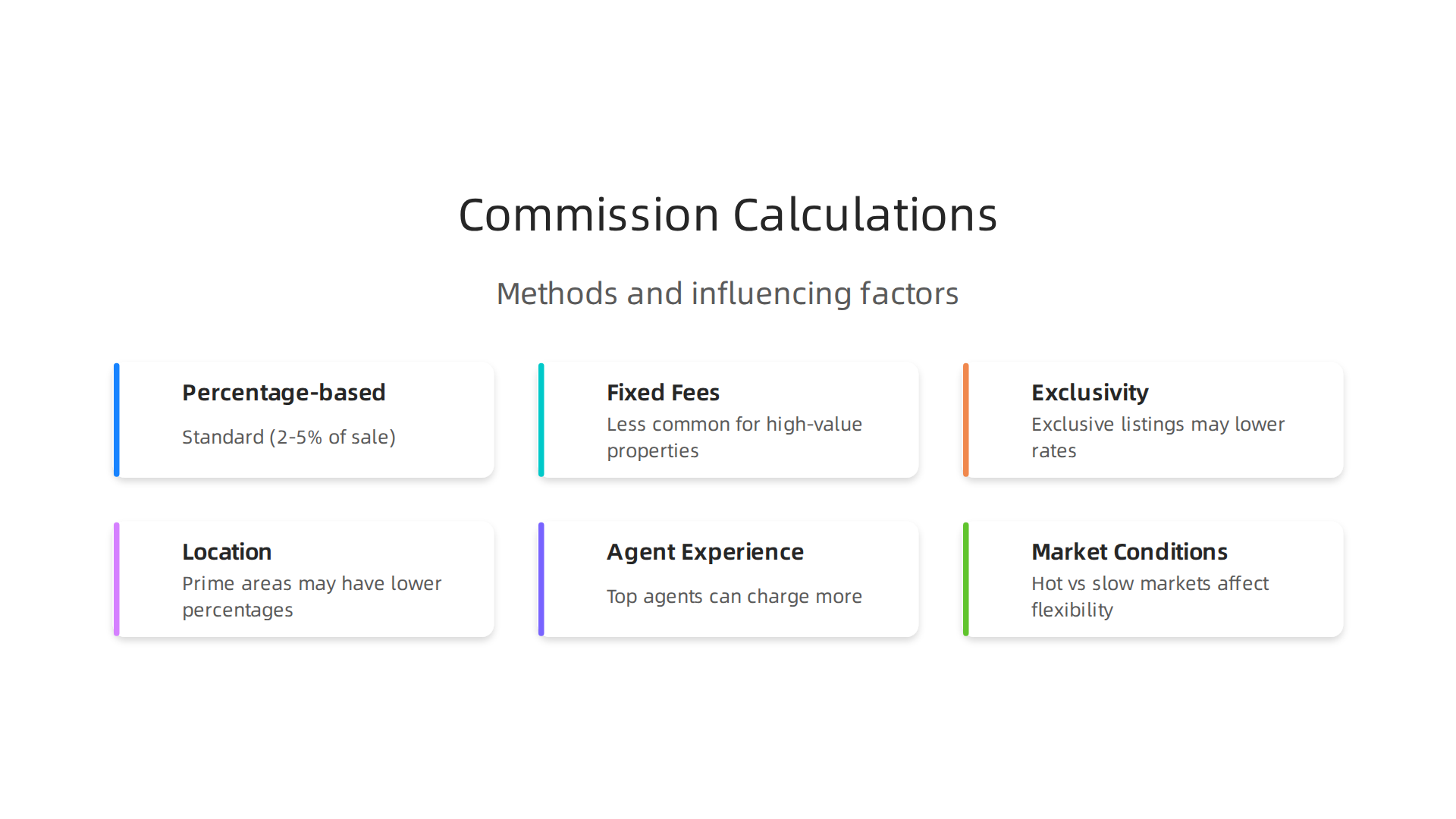
For a residential property, you will often see rates around 2% according to Engel & Völkers. On a AED 2 million villa, that means AED 40,000. For a commercial property, the rate is usually 2% as well, as Excel Properties explains. For rentals, it is typically 5% of the annual rent. So if you rent an apartment for AED 120,000 per year, the agent earns AED 6,000.
Fixed fees are less common but exist. Sellers of high value or luxury properties sometimes negotiate a flat fee instead of a percentage. This works best when the property is very expensive. For example, on a AED 20 million penthouse, a 2% commission would be AED 400,000. The seller might instead agree to a fixed AED 150,000 fee. Both sides win. The seller saves money. The agent still gets a solid payout.
Several factors influence which method you end up with. Exclusivity matters. If you give an agent an exclusive listing, they might lower their rate because they know they won’t have to split the commission with another agency. Location also plays a role. Prime areas like Palm Jumeirah or Downtown Dubai often command lower percentage rates because the total price is already high. Agent experience is another factor. A top performing dubai realtor with a strong track record can charge more. Finally, market conditions shift the numbers. In a hot seller’s market, agents may stick to their standard rates. In a slower market, they become more flexible.
Understanding these calculation methods helps you negotiate better. If you know what to expect, you can ask the right questions when you meet an agent. For deeper tips on the entire transaction process, check our complete guide to Dubai property buying in 2026. It covers everything from agent selection to closing costs.
Who Pays the Commission?
Now you know how commissions are calculated. The next natural question is this. Who actually pays them? The answer depends on the type of transaction you are handling.
For home sales, the seller pays. This is the standard setup in Dubai. The seller agrees to pay a fee to the listing agent.

That fee is a percentage of the sale price. As Excel Properties explains, the seller’s payment is then split between the seller’s agent and the buyer’s agent. So if you are buying a home, you get professional representation at no direct cost to you. The seller covers the full commission for real estate agent services on both sides.
For rentals, the tenant usually pays. In Dubai’s rental market, the person leasing the property covers the agent’s fee. The average commission for real estate agent rentals ranges from 2% to 5% of the annual rent. But this is negotiable. Some landlords offer to split the cost to fill their property faster.
For off-plan purchases, the developer often covers the cost. When you buy a new property directly from a developer, the developer may pay your agent’s commission. This is a common practice in Dubai. It means you can work with an experienced agent without paying extra out of pocket. If you are considering off-plan options, our guide to buying property safely in 2026 explains how to navigate developer deals.
Want the full picture on commissions? Read our complete guide to real estate commission in Dubai for 2026. It covers RERA rules, negotiation tips, and what to expect at closing.
Buyer’s and Seller’s Commission Responsibilities
So now that you know who writes the check, let’s break down what that means for you as a buyer or seller. The rules are straightforward, but they matter.
The seller carries the load. In almost every home sale in Dubai, the seller pays the full commission for real estate agent services on both sides. This cost is often deducted directly from the sale proceeds at closing. So the seller never has to write a separate check, but the amount still comes out of their final profit. As Excel Properties confirms, this is the standard setup.
The buyer rarely pays a separate commission. Here is the thing. If you are buying a home, you do not usually have to pay your agent a fee directly. The seller’s payment covers your agent’s share too. But there is a catch. You may indirectly pay through the purchase price. Sellers often price their homes higher to account for the commission they are covering. So the cost is baked into the deal. One exception is commercial property, where the buyer may be on the hook for a separate 2% commission. Always check before you sign.
Get it in writing. This is the most important rule of all. RERA requires every transaction to have a written agreement, either Form A for buyers or Form F for sellers. This document must clearly state who pays the commission for real estate agent services and how much.

Never rely on a handshake or a promise. If it is not in the contract, it is not guaranteed. For a closer look at how to choose a trustworthy agent, check out our review of FAM Properties.
Understanding these responsibilities upfront saves you surprises later. If you want the complete picture on rates, rules, and negotiation, read our full guide to real estate commission in Dubai for 2026.
Tenant and Landlord Commission Scenarios
Now let’s talk about renting. If you are leasing a home in Dubai, the rules for the commission for real estate agent shift from what buyers and sellers face. Here is how it works.
Tenants typically pay the fee. As a renter, you will usually pay a commission equal to 5% of the annual rent. That works out to about one month’s rent in most cases. This standard commission of real estate agent covers the work the agent did to find your property, arrange viewings, and finalize the lease. Engel & Völkers confirms this is the accepted norm for 2026. So before you look at what real estate agent do for you, know that their fee in a rental deal typically falls on you.
Landlords may pay too. Here is a twist you should know about. If a landlord hires their own letting agent to market the property and find a tenant, they may also pay that agent a separate fee. In this situation, both the tenant and the landlord end up paying a commission of real estate agent. It is less common, but it does happen. Always ask the question upfront. Who else is paying a fee in this deal?
Ejari fees are not commissions. One common mix up happens with the Ejari registration fee. Your Ejari fee is a government charge to officially register your rental contract. It is completely separate from your agent’s commission. Eastern Housing notes that agency rates in Dubai usually fall between 2% and 5%, so ask your agent for a full written breakdown of every cost before you sign a lease.
Knowing these scenarios helps you avoid surprise charges at the last minute. For a deeper look at all the fees involved, check out our complete guide to real estate commission in Dubai for 2026. And if you are just starting your search, our Dubai real estate investment guide has practical steps to follow.
Legal Framework and RERA Regulations
All those rental and buying scenarios we just covered follow one set of rules. The Real Estate Regulatory Agency, or RERA, controls how the commission for real estate agent works in Dubai. Understanding these rules takes the guesswork out of your next move.
The main law is RERA Law No. 9 of 2009. This law sets the ground rules for every agent and broker in the city. Read the full text of the law here. It requires a written agency agreement before any work starts. This document must clearly state the commission of real estate agent along with every single fee. No hidden charges are allowed under RERA rules. Gulf News explains how this law protects buyers and renters by making sure everyone knows the costs upfront.
What are the actual rate caps?
RERA sets a maximum limit on what agents can charge. For property sales, the cap is 5% of the sale price. For leases, it is 5% of the annual rent. These caps apply whether you are buying, selling, or renting. So if you ask what real estate agent do for that fee, the law says they must provide full transparency and act with your best interest in mind.
But here is the part many people miss. Those rates are just the ceiling. You can negotiate a lower rate with your agent. Many agents will agree to a lower fee, especially on higher value properties.
How to use this to your advantage
If you are working with a dubai realtor, always ask for a written fee breakdown before signing anything. Compare it against the RERA caps. If something seems off, you have the right to question it. Baker McKenzie confirms these legal protections are in place to safeguard your interests.
For a complete breakdown of standard rates and smart negotiation tips, check our 2026 guide to real estate commission in Dubai. It is a practical resource to help you avoid overpaying.
And if you are still searching for a reliable agent, reading our FAM Properties Dubai review will show you exactly what to look for when vetting a realtor.
Commission Splits Between Agents and Brokers
Now you know the legal caps on the commission for real estate agent. But here is the part most clients miss. The agent you work with does not keep that entire commission.
How the split works
Agencies and brokers take a cut of the total commission of real estate agent first. These splits vary a lot.
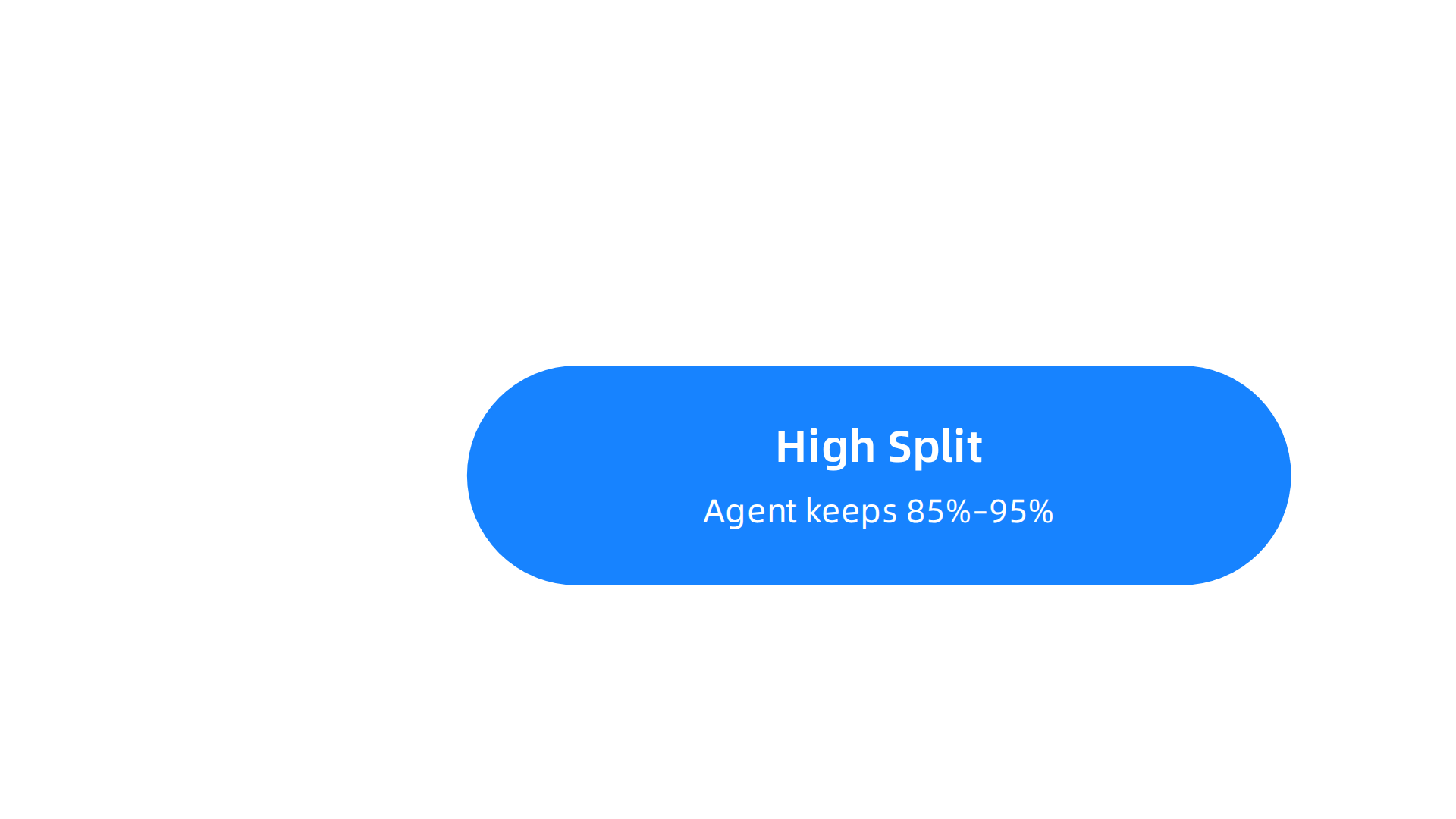
Some brokerages offer a 95/5 split. The agent keeps 95% of the commission [1]. Others work on a 50/50 arrangement [2]. Many use tiered splits. The agent keeps more once they hit a sales target [3].
| Split Type | Agent Keeps | Broker Keeps |
|---|---|---|
| High | 85% – 95% | 5% – 15% |
| Medium | 60% – 80% | 20% – 40% |
| Low | 50% | 50% |
The real cost of doing business
It gets tighter. From the agent’s share, they still pay desk fees and marketing costs [4]. Their take home pay is smaller than the gross commission of real estate agent. In 2026, margins are compressing across the industry [5].
Why this matters to you
This affects your experience with any dubai realtor. When you understand what real estate agent do with their pay, you see their motivation clearly.
An agent might push a property because their agency pays a higher split on that deal. They might rush a closing to cover their monthly desk fee. Knowing this puts you in control.
You want an agent whose priorities match yours. Our investment strategies for 2026 guide helps you align their goals with yours. And if you are a first time buyer, our safe buying guide for 2026 helps you navigate these motivations confidently.
[1] https://listwithclever.com/real-estate-blog/what-is-re-maxs-commission-split-for-real-estate-agents/
[2] https://www.engelvoelkers.com/de/en/resources/broker-commission
[3] https://www.totalbrokerage.com/blog/understanding-agent-commission-plans
[4] https://www.speichergroup.com/insights/real-estate-agent-commissions
[5] https://nbeliterealty.com/how-agent-earnings-are-shifting-with-real-estate-commission-changes-in-2026/
How Splits Affect Service Quality
Here is the truth most buyers and sellers never hear. The commission for real estate agent does more than pay the bills. It directly shapes how that agent treats you.
When a higher split helps you
Agents who keep most of their commission of real estate agent often give better service. They invest in marketing. They spend time on research. They return calls fast. Why? Because every deal matters more to their bottom line.
But there is a catch. Some agents with high splits feel pressure to close quickly [1]. They need that paycheck to cover their desk fees. So they might push you toward a fast deal instead of the right one.
When a lower split hurts you
Newer agents often work on 50/50 splits or lower [2]. They get less support and less training [3]. Their brokerage takes a bigger cut, leaving them with less motivation to go the extra mile.
This does not mean every agent on a low split is bad. But it does mean you should ask questions.
What you can do
Here is a simple tactic. Ask any dubai realtor about their split structure. A confident agent will answer honestly. One who gets vague might not have your best interests in mind.
A good split does not guarantee good service. But understanding the numbers helps you see what real estate agent do behind the scenes.

If you want a step by step approach to vetting agents, our safe buying guide for 2026 walks you through exactly what to ask. And our investment strategies for 2026 guide shows you how to align an agent’s incentives with your own.
[1] https://nbeliterealty.com/how-agent-earnings-are-shifting-with-real-estate-commission-changes-in-2026/
[2] https://www.engelvoelkers.com/de/en/resources/broker-commission
[3] https://www.usrealtytraining.com/blogs/best-real-estate-brokerages
Negotiating Commissions: What You Need to Know
Here is something many buyers and sellers get wrong. They think the commission for real estate agent is a fixed number. But in most places, including Dubai, it is not. You can talk about it. You can ask for a different deal.
The key is to know what is fair and what is not. In Dubai, the standard rate for a commission of real estate agent usually sits around 2% of the sale price [1]. But that is just a starting point. Depending on the property value, the market conditions, and the agent’s experience, you can often adjust that number.
Smart strategies to try
When you sit down to negotiate, here are a few tactics that work well:
- Compare offers from multiple agents. Talk to at least two or three dubai realtor professionals. See what rates they suggest. Use one offer to guide your conversation with another agent. This gives you real leverage.
- Ask about a flat fee for high-value properties. If you are buying or selling a luxury home worth millions, a percentage can feel huge. Some agents will agree to a flat fee instead. That saves you money and still pays them well.
- Propose performance-based incentives. Tell the agent you are willing to pay a bonus if they sell your property above a certain price or within a set time. This lines up their motivation with yours. It also shows you understand what real estate agent do every day to close a deal.
Red flags to watch for
Not every agent will love it when you bring up negotiation. That is fine. But look out for these warning signs:
- They will not put the commission in writing.
- They pressure you to pay a large fee upfront.
- They quote a rate much higher than what other agents in the area charge.
If you see any of these, it might be time to walk away and find a more transparent partner.
You have more power than you think. A fair discussion about rates can lead to a better deal for both sides. And if you want to see exactly how commissions work in Dubai, including standard rates and RERA rules, our detailed guide on real estate commission in Dubai walks you through every step.
[1] https://www.engelvoelkers.com/ae/en/resources/how-much-is-the-real-estate-agent-commission-in-dubai
Tax Implications of Real Estate Commission Income
Now that you know how to negotiate your commission for real estate agent, let us talk about something just as important: taxes. If you are an agent in Dubai, you need to understand what you owe and when to pay it.
The good news? There is no personal income tax in Dubai. That means the money you earn from your commission of real estate agent is not taxed at the personal level. But you still have business taxes to deal with.
VAT is your first responsibility
Every time you earn a commission, you must charge 5% Value Added Tax (VAT) on top of that fee. The standard VAT rate in the UAE is 5% for most goods and services [1]. This applies to real estate commissions too. You need to issue a proper invoice to your client and then remit that VAT to the Federal Tax Authority (FTA). If you do not register for VAT and your annual turnover goes above the threshold, you could face fines.
Corporate tax changed in 2024
Starting in 2024, the UAE introduced a 9% corporate tax on net profits for businesses that earn above a certain threshold [2]. If you run your own agency as a registered business, this rule applies to you. You pay this tax only on your profits after expenses. So things like marketing costs, office rent, and even some professional fees can reduce what you owe.
What this means for you
Here is the simple version. You keep the full commission amount as income. You add 5% VAT to your invoices and send that money to the government. And if your business profits are high enough, you pay 9% corporate tax on those profits.
If you want to dig deeper into how the dubai realtor market works and see the full picture of expenses and earnings, our guide on Dubai real estate investment strategies for 2026 covers the financial side from both the agent and client perspective.
[1] https://www.savoryandpartners.com/blog/dubai-tax-rate-guide
[2] https://ainfinance.com/BlogsDetail/uae-real-estate-vat-corporate-tax-guide-2026-blog
VAT on Commission: What Clients Need to Know
Every time you pay a commission for real estate agent in Dubai, you will see a 5% VAT charge added to your invoice. This is not optional.

The standard VAT rate in the UAE is 5% for most goods and services, including real estate commissions [1][4].
If you run a business and are registered for VAT, you can reclaim this 5%. It becomes an input tax credit on your returns, which lowers your total expense [5]. To do this, you must get a valid VAT invoice from your agent. Do not skip this step. A proper invoice is your proof for the tax authority.
A professional dubai realtor will handle this correctly. If an agent tries to avoid charging VAT or offers a deal "without VAT," walk away. They are breaking the law and putting you at risk of fines and invalid contracts. This is a major sign they are not following what real estate agent do correctly in a regulated market like Dubai.
For a complete run-down on what rates are fair and how to negotiate the commission of real estate agent you pay, take a look at our detailed guide on real estate commission in Dubai 2026. It helps you know exactly what to expect before you sign anything.
Always confirm the agent is RERA-certified and issuing the correct documentation. You can learn more about finding a trustworthy professional in our guide to buying property safely in Dubai.
Summary
This guide explains how real estate agent commissions work in Dubai in 2026, covering legal rules, typical rates, who pays in different transactions, and practical negotiation tips. It shows that commissions are generally a success fee paid only on a completed deal, with sales commissions typically between 2%–5% and rental commissions commonly around 5% of annual rent. You’ll learn the difference between percentage and flat fees, when developers or sellers cover costs, and how RERA caps and written agency forms protect you. The article also breaks down how agencies split commissions with brokers, the VAT and tax rules agents must follow, and clear steps to negotiate and avoid surprises. After reading, you’ll know what to ask, what to expect on contracts, and how to pick an agent who aligns with your interests.