

Introduction
Dubai’s property market in 2026 is buzzing with opportunity. You do not need to be a real estate tycoon to get involved. Many people want to invest but feel stuck. High prices, complex rules, and the search for a trustworthy partner lead to information overload and missed chances.
There is a simpler way. A reit real estate investment trust (REIT) lets you own a slice of Dubai’s top buildings without the headache of managing them yourself.

Think of it as a stock that pays you rent. These funds are tightly regulated by the Dubai Financial Services Authority (DFSA) Citation: DFSA Collective Investment Funds. That gives you more transparency and safety.
In this guide, we break down everything you need to know about real estate investment trusts reits in Dubai. We cover the types, the top funds for 2026, how to evaluate them, and the tax rules. By the end, you will have a clear roadmap.
If you prefer owning physical property or want a mix of both strategies, we have you covered. Check out our complete Dubai Real Estate Investment 2026 Guide for more investing in real estate tips.

Ready to make a smart move? Whether you pick REITs, direct investment, or both, expert advice helps you avoid mistakes. Book your free consultation with Ayaz Salman today. Let us help you navigate the Dubai market.
Understanding REITs and Their Role in Dubai’s Real Estate Market
So what is a reit real estate investment trust exactly? Think of it as a company that owns and runs income-producing buildings like offices, malls, or apartment complexes. Instead of buying a whole villa or tower yourself, you buy shares in the trust. The rent your properties earn flows back to you as regular dividends.
In Dubai, this setup follows strict rules. The Dubai Financial Services Authority (DFSA) oversees real estate investment trusts reits through its collective investment fund framework Citation: DFSA Collective Investment Funds.

The Securities and Commodities Authority (SCA) also plays a role in regulation. This double oversight gives you more protection compared to buying a single apartment on your own.
How REITs Compare to Direct Property Ownership
| Feature | REIT Investment | Direct Property Ownership |
|---|---|---|
| Liquidity | High. You sell shares on the stock exchange anytime. | Low. Selling a property can take months. |
| Diversification | Built in. One REIT owns many buildings across sectors. | Limited. You likely own one or two properties. |
| Professional Management | Yes. Fund managers handle all maintenance, tenants, and legal work. | No. You deal with repairs, vacancies, and real estate agents yourself. |
| Entry Cost | Low. Buy as few shares as you want. | High. You need a large down payment plus fees. |
For someone starting their investing in real estate tips journey, REITs offer a great way to get market exposure without becoming a tycoon real estate mogul overnight. You skip the struggle of finding a trustworthy agent or negotiating deals. The fund manager does all that heavy lifting.
If you are comparing REIT ownership to direct buying, you might also want to learn how to vet the professionals you actually need for direct deals. Check out our guide on how to find a trustworthy real estate brokerage near me in Dubai for practical steps.
The bottom line? REITs let you dip your toes into the Dubai market with less stress and more flexibility.

But which types are available here in 2026? That is what we cover next.
Types of Real Estate Investment Funds Available in Dubai
Now that you know how REITs work, let’s look at the different types of reit real estate investment trusts and other funds you can actually invest in right here in Dubai. The good news? You have plenty of options, no matter how much money you are starting with.
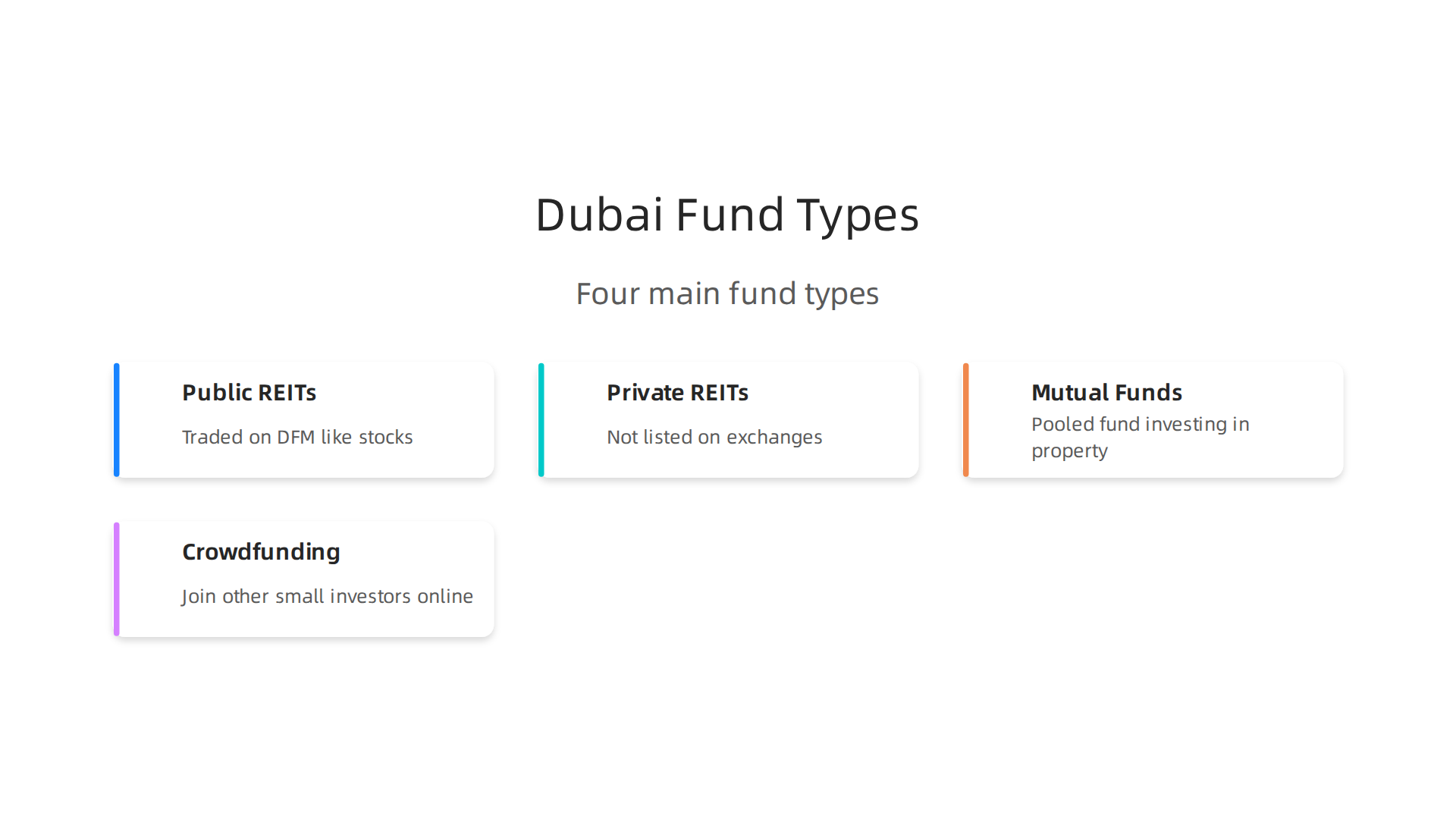
Dubai’s market offers four main types of real estate investment funds in 2026. Each one works a bit differently. Here is how they compare.
| Fund Type | How It Works | Best For |
|---|---|---|
| Public REITs | Traded on the Dubai Financial Market (DFM) like stocks. You buy and sell shares easily. | Investors who want high liquidity and easy entry. |
| Private REITs | Not listed on any exchange. You invest directly with a fund manager. | Investors who can lock up money for a few years in exchange for potentially higher returns. |
| Real Estate Mutual Funds | A pool of money managed by a professional team that invests in property-related assets. | People who want broader exposure without picking individual properties. |
| Crowdfunding Platforms | You join with other small investors online to fund a specific property project. | Beginners who want to start with very small amounts. |
Public REITs: The Most Popular Choice
Public REITs are the easiest type to understand. They trade on the DFM just like any other stock. You can buy a few shares today and sell them tomorrow if you change your mind. The DFM lists several options, including Sharia-compliant REITs, which follow Islamic finance rules Citation: DFM REITs Page.
A big example making headlines in 2026 is the Dubai Residential REIT. It is set to become the largest listed REIT in the entire GCC region. This single fund manages 35,700 residential units across 21 communities, including places like Bluewaters Residences and City Walk Residences Citation: The National News. That is the power of a public REIT. You get a slice of thousands of homes, not just one.
Private REITs and Other Options
Private REITs are a bit different. They are not listed on the DFM. This means you cannot sell your shares easily. But the trade off is that they often deliver higher returns because the fund manager can take a longer view. If you are serious about investing in real estate tips, private REITs can be a smart addition, but only if you are comfortable not touching that money for a few years.
Real estate mutual funds and crowdfunding platforms give you even more flexibility. With crowdfunding, you might put in as little as a few hundred dirhams to fund a specific villa renovation or a new apartment building. It is a great way to test the water without becoming a tycoon real estate player overnight.
No matter which path you choose, you will still want to work with a trusted advisor who knows the landscape. A professional can help you decide between public and private funds based on your goals. And if you ever decide to buy physical property instead, our guide on how to find a trustworthy real estate brokerage near me in Dubai will point you in the right direction.
The choice really comes down to your timeline and your comfort with risk. Public REITs offer the most freedom. Private funds and crowdfunding offer more potential reward. Pick the one that fits your life.
Top REITs Listed on the Dubai Financial Market (DFM)
We have covered the different types of funds. Now let’s look at the specific real estate investment trusts reits you can actually buy on the DFM.
The Dubai Financial Market is the main home for public REITs. You can buy and sell shares in these funds just like any other stock. Three main names stand out for investors in 2026.
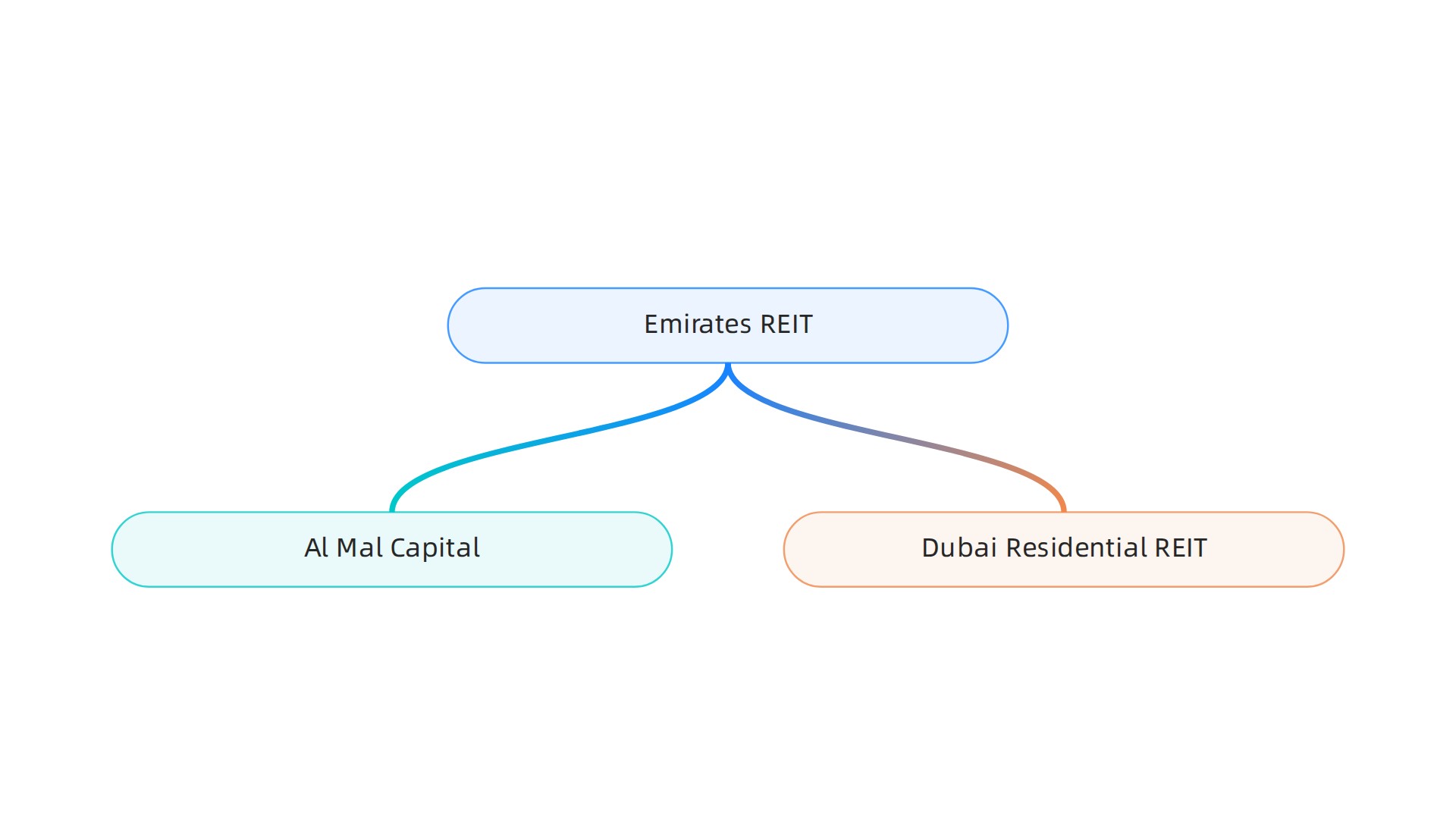
Emirates REIT is one of the oldest and most established. It mainly puts its money into commercial properties and schools. If you believe in Dubai’s business and education sectors, this is a solid option to consider.
Al Mal Capital REIT takes a mixed approach. It holds a portfolio of both residential and commercial assets. This gives you a bit of both worlds inside a single share. It is a good pick if you want balance without buying multiple funds.
The biggest story this year is the Dubai Residential REIT. This fund recently listed on the DFM and is already the largest listed REIT in the GCC by a wide margin Citation: The National News. It manages over 35,700 residential units across 21 communities. That includes popular neighborhoods like City Walk and Bluewaters Residences Citation: Dubai Holding Press Release. It is also Sharia-compliant, which makes it available to a wide range of investors Citation: Investing.com. You can find the full list of all listed REITs directly on the DFM website Citation: DFM Listed Securities.
See the difference? Each reit real estate investment trusts focuses on a different piece of the market. One is heavy in offices. One mixes residential and commercial. And one is purely residential. Your job is to pick the sector you are most confident about.
You also need to compare their performance numbers. Look at the dividend yield and the Net Asset Value (NAV). These tell you how much cash the fund returns to you and what the underlying property assets are worth. This kind of homework is exactly what investing in real estate tips teach you.
If you want to learn how to fit these REITs into a bigger plan, our full guide on Dubai real estate investment strategies for 2026 can help you see the complete picture.
So, which REIT is right for you? It depends on your goals. Do you want school exposure, mixed assets, or pure residential units?
How to Evaluate a REIT or Real Estate Fund in Dubai
Now that you know the main players on the DFM, how do you tell which one is a winner? You do not just guess. You use the same smart methods that the pros use. Here is your simple framework for checking any reit real estate investment trusts before you put your money in.
The Key Numbers to Check
Every serious investor starts with Funds from Operations (FFO). Think of FFO as the real cash a REIT makes from its properties. It adds back depreciation, which is not a real cash cost. This gives you a cleaner view of how the business is actually performing.
Next, look at the Price/FFO ratio. This is just like the P/E ratio for a stock. A lower ratio might mean the fund is undervalued. A very high ratio might mean it is too expensive.
You also want to check the dividend yield. This is the money you get paid each year as a percentage of the share price. But do not stop there. Look at the payout ratio. Is the fund paying out all of its cash? A payout ratio that is too high might mean the fund has little left over for maintenance or new buys.
The "Behind the Scenes" Factors
Numbers only tell part of the story. You also need to think about:
- Management quality. Does the team have a good history? Do they own shares in the fund themselves? This shows they believe in it.
- Portfolio occupancy. If their buildings are mostly empty, the rent income will fall. Look for occupancy rates above 80%.
- Leverage and interest coverage. How much debt does the fund have? Can it easily pay its interest bills? Too much debt can kill a fund when rates go up.
These are the kind of investing in real estate tips that separate beginners from smart buyers.
Your Due Diligence Checklist
Before you buy any real estate investment trusts reits, do your homework.
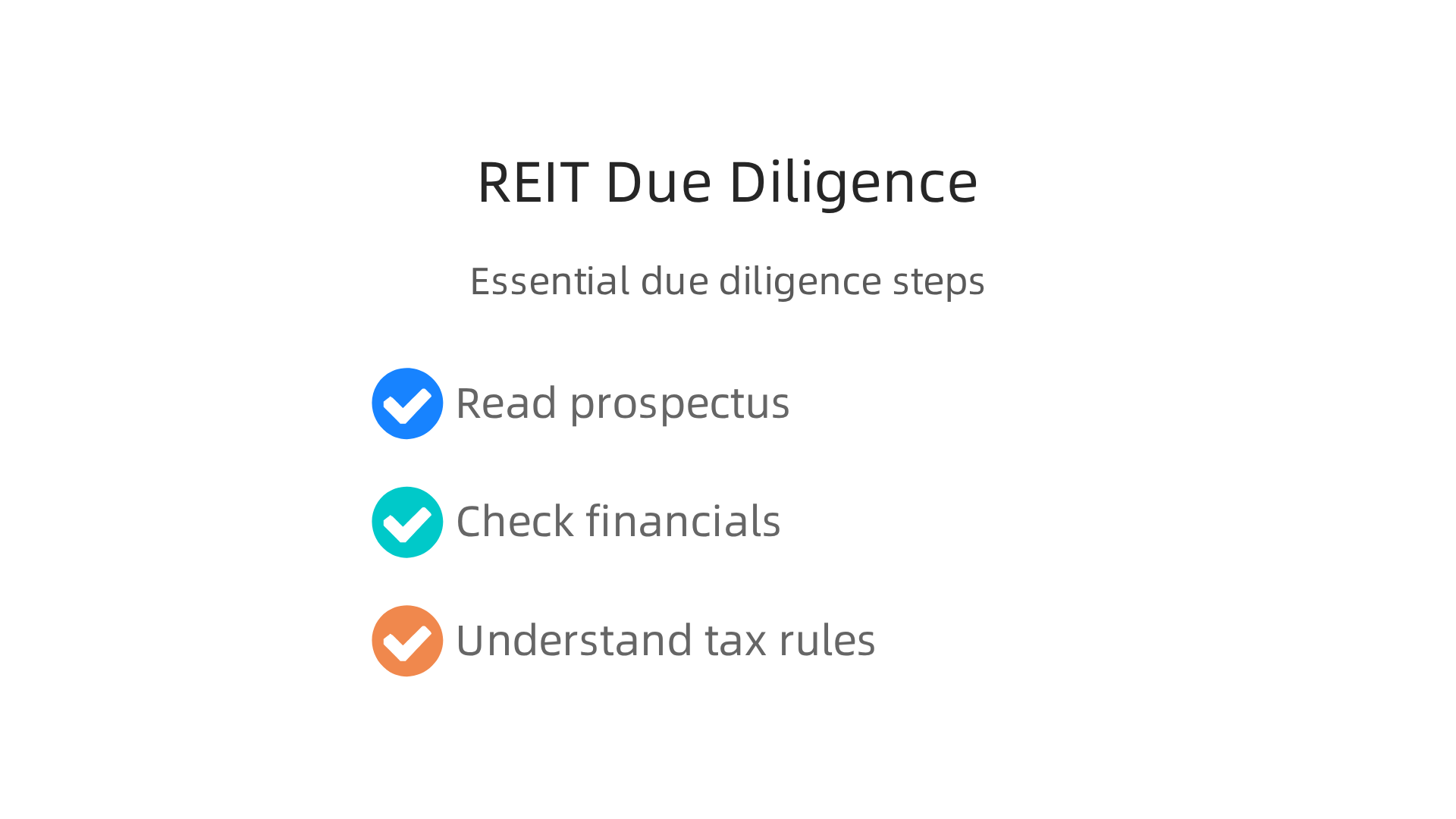
- Read the prospectus. This is the rule book for the fund.
- Check the audited financials and annual reports. These tell you if the numbers are real.
- Understand the tax rules. Starting in 2025, the UAE introduced specific corporate tax rules for REIT investors. Under the updated rules, investors holding units in a qualifying REIT will be taxed on a portion of their income Citation: The Finance World. The standard UAE corporate tax rate is 9% for income above AED 375,000 Citation: UAE Government Portal. Do not skip this step.
If you want a full blueprint on building your property portfolio the right way, our Dubai real estate investment strategies for 2026 guide can help you see the bigger picture.
Evaluating a REIT takes some work. But this work helps you avoid mistakes and pick the funds that will actually grow your money over time.

[FREE Dubai Real Estate Consultation] – Connect with Ayaz Salman for Free Consultation.
Tax Implications and Legal Framework for REIT Investments in Dubai
You picked up earlier that taxes matter when you check any fund. Now let’s dig into the full picture. For a long time, Dubai was known as a place where you paid almost nothing in taxes on property income. That made it a magnet for investors from all over the world. But things changed starting in 2025. If you want to make smart moves with reit real estate investment trusts, you need to know these new rules.
The Corporate Tax Shift in 2025 and 2026
The UAE brought in a federal corporate tax recently. The rates are simple to understand. You pay 0% on taxable income up to AED 375,000. You pay 9% on any income above that amount Citation: UAE Government. For most individual investors, this means your personal REIT income still stays mostly tax free. But it is not automatic anymore.
Then in 2025, the government released special rules just for REIT investors. Here is the big part. The rules say that investors who hold units in a qualifying REIT will be taxed on 80% of their income from the fund Citation: The Finance World. This means 20% of your REIT income might be completely tax free. But the other 80% counts toward your taxable income. You can watch this detailed overview of the rules to see how it applies to your situation.
How REITs Are Regulated
You also need to know who watches over these funds. Not all real estate investment trusts reits follow the same rules. The regulator depends on where the fund is based.
- DIFC (Dubai International Financial Centre): REITs here are regulated by the DFSA (Dubai Financial Services Authority). They follow strict international standards for reporting and governance.
- Onshore (Mainland Dubai): REITs that operate outside the DIFC are regulated by the SCA (Securities and Commodities Authority). They have their own set of rules.
Both regulators require strong disclosure. This means the fund must tell you about its finances, its risks, and how it makes decisions. This transparency is one of the key investing in real estate tips that keeps the market honest.
The Good News for Foreign Investors
If you live outside the UAE, here is the part you will really like. The UAE generally charges 0% withholding tax on dividends paid to foreign investors. This means if your REIT pays you a dividend, the government does not take a cut before it reaches your bank account. That is a huge advantage compared to many other countries.
What This Means for Your Wallet
Here is the bottom line. Dubai is no longer a total tax free zone for REITs. But the rules are still very friendly. For most individual investors, especially those whose total taxable income stays under AED 375,000, the actual tax bill is likely to be zero.
The smartest tycoon real estate investors plan ahead. They track their income. They understand the 80% rule. And they know which regulator oversees their fund.
If you want to make sure you are buying into a REIT the right way, you need a complete view of the market. Our Dubai real estate investment 2026 guide to buying property safely walks you through every step.
And if you want to talk through the tax rules with someone who knows the Dubai market inside out, you can get a free consultation with Ayaz Salman right here
Risks and Challenges of Investing in Dubai REITs
So the tax rules are manageable. And the dividends can be solid, with average yields for Dubai-based REITs expected to land between 6% and 8% in 2026, which is higher than many global markets Citation: Kaizen AMS. But just like any reit real estate investment trusts, there are real risks you need to understand before you put your money in.
Let’s talk about the three biggest ones.
Market Risk: Dubai’s Real Estate Cycles
Here is the thing. Dubai property prices go up and down in cycles. When the market is hot, values rise fast. When it cools down, they can drop just as quickly. Your REIT units will feel those changes.
This affects you in two ways. First, the value of your investment can fall if property prices drop. Second, rental income can shrink too. If too many new buildings come onto the market at once, landlords have to lower rents to find tenants. This oversupply in certain sectors is a real risk that puts pressure on REIT performance Citation: Property Finder.
Currency Risk for Foreign Investors
If you live outside the UAE, you need to think about currency. The UAE dirham is pegged to the US dollar. That gives you some stability. But your home currency might not stay steady against the dollar.
When the US dollar gets stronger, your REIT dividends are worth less in your local money. When it gets weaker, they are worth more. You cannot control this. But you should be aware that it adds another layer of uncertainty to your returns.
Concentration Risk: Putting All Your Eggs in One Basket
Some real estate investment trusts reits focus on just one type of property. Maybe only office buildings in one area. Or only hotels in one part of Dubai. This is called concentration risk.
If that one sector struggles, your whole investment struggles. For example, if a REIT owns mostly hotels and tourism slows down, the fund’s income takes a direct hit. The same goes for a fund that is tied too heavily to a single large development project Citation: BnW Developments.
A smarter investing in real estate tips is to look for REITs that spread their money across different property types. Offices, retail, residential, and industrial assets together can help balance the ups and downs.
How to Protect Yourself
You cannot remove risk completely. But you can manage it. Here are a few ways.
- Diversify across REITs. Do not buy only one fund. Spread your investment across two or three different REITs with different focuses.
- Check the fund’s holdings. Look at what properties the REIT owns. Are they all in one sector? Are they all in one development? That is a red flag.
- Understand the cycle. Pay attention to the Dubai market. Are developers building too much? Are rents going up or down? This context helps you make better timing decisions.
Being a smart tycoon real estate investor means knowing the risks before they hit you. If you want help building a plan that protects your money while still growing it, the right guidance makes all the difference. You can get a free consultation with Ayaz Salman right here to go over your specific situation and find the safest path forward.
For a deeper look at how to approach the whole market, our Dubai real estate investment 2026 strategies guide covers everything from risk management to choosing the right property for your goals.
Future Outlook for REITs in Dubai (2026 and Beyond)
The risks are real, but so is the opportunity. If you are thinking about investing in Dubai REITs, the future looks promising for several reasons.

Let me walk you through what is coming.
Economic Diversification Keeps Demand Strong
Dubai has been working hard to move beyond oil. The city now focuses on tourism, tech, trade, and finance. This plan is working. The Dubai real estate market forecast 2026-2027 shows a strong market with steady demand for quality properties Citation: MAK Developers. The Expo 2020 legacy also plays a big part. The infrastructure built for the Expo, including new roads, hotels, and business zones, creates a solid base for institutional-grade real estate. This means REITs that own these kinds of properties have a strong foundation for growth.
More REITs Coming to the Market
Here is an exciting trend. More REITs are expected to launch in Dubai in 2026 and 2027. We are also likely to see more initial public offerings (IPOs) of real estate investment trusts. This is great news for investors. Why? Because more choices mean you can find a REIT that matches your goals better. It also means more competition, which pushes fund managers to perform well.
The Dubai property market has largely stabilised as we move through 2026 Citation: Magus Properties. This stability gives new REITs a good environment to launch and grow.
Better Rules Mean More Trust
The Dubai government is making the rules around REITs stronger. They are asking for more transparency. This means REITs have to share clearer information about their holdings, income, and expenses. They are also pushing for better ESG reporting (environmental, social, and governance factors). This matters because international investors look for these things.
When a market has clear rules and transparency, bigger investors from around the world feel safer putting their money in. That brings more capital into Dubai REITs, which can help grow the whole sector.
What This Means for You
So where does this leave you as an investor? The outlook for reit real estate investment trusts in Dubai is positive. The city’s economy is strong. New funds are launching. And regulations are getting better. This combination makes Dubai an attractive place for real estate investment trusts reits in 2026 and beyond.
If you want to take advantage of this growing market, the best step is to work with someone who knows the local market inside and out. Understanding how to pick the right REIT and timing your entry are both key investing in real estate tips that can make a big difference to your returns.
The smart tycoon real estate investor looks ahead. And the future of Dubai REITs looks bright.
If you want to get started or need help choosing the right REIT for your portfolio, connect with Ayaz Salman for a free consultation to talk about your options and build a plan that fits your goals.
For a complete overview of how to invest in Dubai property this year, check out our Dubai real estate investment 2026 guide.
How to Start Investing in Dubai REITs
So you are ready to take action. That is the hardest part. But how do you actually buy shares in a reit real estate investment trust here in Dubai? Let me break it down into simple steps.
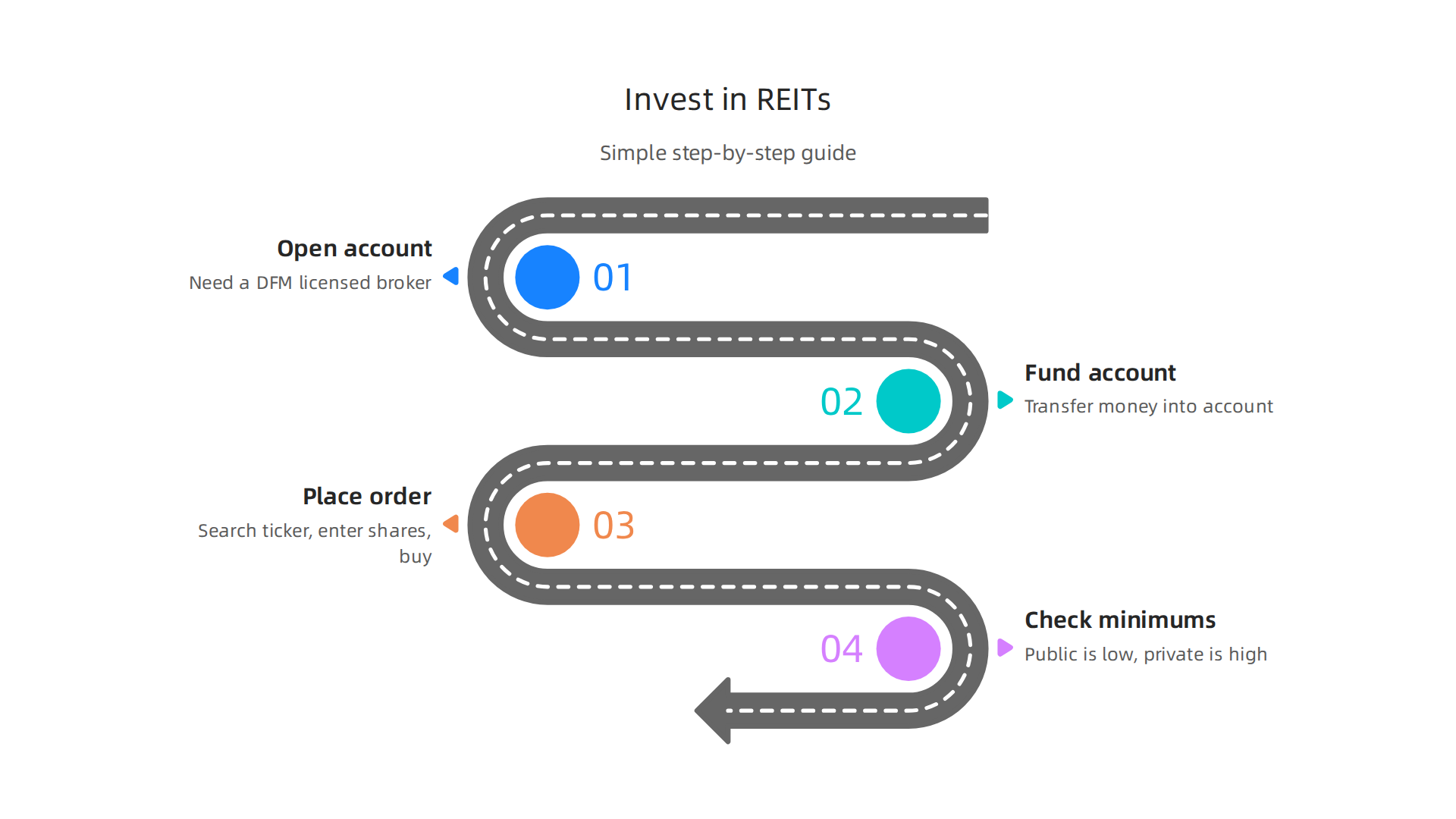
It is much easier than buying a physical apartment.
Step 1: Open a Brokerage Account
First, you need a trading account. Think of it like a bank account for stocks.
You need a broker who is licensed by the Dubai Financial Market (DFM). Many online platforms and traditional banks in Dubai offer this service. You will go through KYC (Know Your Customer). That just means you share your passport, a proof of address, and maybe a recent bank statement. It usually takes a day or two to get approved.
If you are unsure which platform to pick, remember that choosing a service partner is similar to finding a trustworthy real estate brokerage. You want someone reliable who follows the rules. The DFM itself has clear guidelines to protect investors like you Citation: DFM REITs overview.
Step 2: Fund Your Account
Once your account is active, you transfer money into it. A standard bank transfer from your account usually works fine. Once the money lands, you are ready to trade.
Step 3: Place Your Buy Order
This is the easiest part. Log in to your platform. Search for the REIT ticker symbol. Enter how many shares you want. Click buy. That is it.
Step 4: Understand the Minimum Investment
Here is a key investing in real estate tips that many people get wrong.
For public REITs (listed on the stock market), the minimum investment is just the price of one share. That can be less than $5. Yes, you can start investing in Dubai real estate real estate investment trusts reits for the cost of a meal.
But private REITs are different. They are not listed on the stock exchange. They usually ask for a minimum investment of $50,000 to $250,000. These are often for the tycoon real estate crowd or high-net-worth individuals.
A Smart Strategy for Beginners
Many people ask if they should go public or private. Public REITs are liquid, meaning you can sell them quickly. Private REITs might offer higher returns but lock your money up for years.
According to market experts, Dubai REITs have shown strong yields and resilience in 2026 Citation: Kaizen Ams REIT analysis. You do not need a mountain of cash to get started. You just need to take the first step.
If you want to match the right REIT to your financial goals, you don’t have to figure it out alone.
Connect with Ayaz Salman for a free consultation to talk about whether public or private REITs fit your plan best. He can help you build a strategy that makes sense for your future.
Summary
This guide explains how real estate investment trusts (REITs) let you own income-producing Dubai property without buying or managing buildings yourself. It describes the main fund types available in 2026—public and private REITs, mutual funds and crowdfunding—then highlights leading DFM-listed names like Emirates REIT, Al Mal Capital REIT and the large Dubai Residential REIT. You will learn the key metrics to evaluate a fund (FFO, price/FFO, dividend yield, payout ratio), the regulatory landscape (DFSA, SCA, DIFC) and recent tax changes including the UAE corporate tax and the 80% rule for REIT income. The article covers risks—market cycles, currency and concentration—and practical steps to open a brokerage account, place buy orders and understand minimum investments. It also explains why more REITs and stronger disclosure make Dubai attractive in 2026 and how to blend REITs with direct ownership for a balanced portfolio. By the end, readers have a clear action plan to compare funds, manage risk, and begin investing in Dubai REITs.