

Introduction
You have found the perfect apartment in Dubai Marina. The views are stunning. The price seems fair. Then your agent mentions the commission, and suddenly you realize you have no idea what you should actually be paying.
That feeling of uncertainty is incredibly common.
Real estate commissions are one of the biggest costs in any property deal in Dubai. Whether you are buying a villa on Palm Jumeirah or renting a studio in Business Bay, the fees add up fast. Yet most people go into these transactions without a clear picture of what is standard, what is fair, and what they can negotiate.
The problem is simple. There is too much information and not enough clarity. You might hear that the standard rate is 2%, but then someone else tells you it is 5%. A friend says the seller pays. Another person says the buyer pays. The official rates from the Real Estate Regulatory Authority are guidelines rather than fixed rules, which leaves plenty of room for confusion.
According to the most recent data on standard commission rates, real estate agent commission in Dubai usually sits at 2% of the purchase price for residential sales. But that number only tells part of the story. How much of that goes to the actual agent? What happens with off-plan properties? And what about rentals where the tenant pays 5% of the annual rent?
This guide exists to cut through that noise.
We built a clear, data-driven framework that helps you calculate exactly what you should expect to pay as a commission. You will learn the standard rates for every type of transaction in the Dubai property market in 2026. More importantly, you will walk away knowing how to verify those numbers and negotiate confidently when the situation calls for it.
Ready to take the guesswork out of your next property deal?
Before we dive into the numbers, make sure you know how to evaluate the person on the other side of the table. Read our guide on how to choose the right real estate and investment company in Dubai so you start with a trustworthy partner from day one.

And if you want personalized advice tailored to your specific situation, reach out for a free consultation with Ayaz Salman. He can walk you through the numbers and help you make a confident decision.
Understanding Real Estate Agent Commissions in Dubai
Before you can use a commission calculator, you need to understand the basics. And here’s the thing: the commission structure in Dubai is different from what most people expect.
Let’s break it down simply.
How commissions work for sales
For residential property sales, the standard rate is typically 2% of the purchase price. That 2% applies to both sides of the deal in most cases. The buyer pays 2% to their agent, and the seller pays 2% to their agent. Some market sources confirm that this dual 2% structure has become the new normal in Dubai.
But here is where it gets interesting. For off-plan properties bought directly from a developer, the buyer usually pays zero commission. The developer pays the agent instead. Those developer-paid commissions can range from 2% all the way up to 8% depending on the project. That is a completely different situation from buying a resale home in Dubai Marina.
How commissions work for rentals
Rental transactions follow a different formula. The standard commission is 5% of the annual rent, and the tenant pays this fee when signing the lease agreement. For lower-value rentals, some agencies charge a flat fee of AED 5,000 instead of the percentage. Landlords may also pay a separate fee to their agent, typically ranging from 0% to 8%.
For a full breakdown of every rate across sales, rentals, and commercial properties, check out the details on standard commission rates in Dubai.
Why this matters for your calculator
Knowing these base numbers is the first step toward using any real estate agent commission calculator effectively. The calculator needs accurate inputs to give you accurate outputs. If you plug in the wrong rate or the wrong payer, the result will be useless.
So before you crunch numbers, ask yourself three questions:
- Am I buying resale or off-plan?
- Am I the buyer, the seller, or the tenant?
- Is this a residential or commercial transaction?
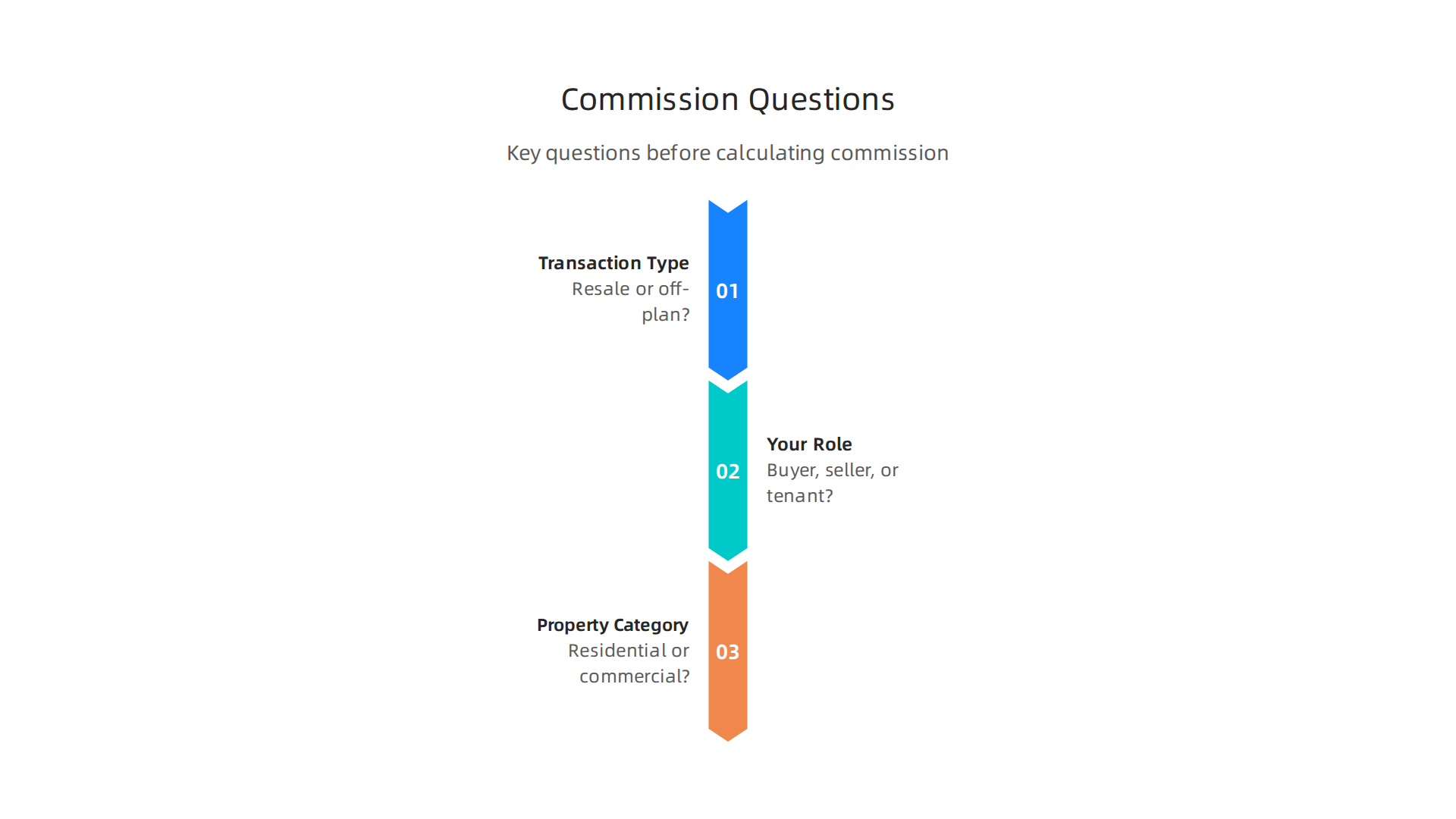
Your answers change everything.
If you want a clearer picture of the full costs involved in a Dubai property purchase, read our trust-first guide for Dubai buyers and investors. It walks you through all the fees you need to budget for.
Now that you understand the basic rates, you are ready to calculate what you will actually owe in your specific deal.
The Standard Commission Structure: Who Pays and How Much?
Here is where things can get a little confusing. The rates are clear, but who actually pays them changes depending on the deal type. Let me clear that up for you.
Sales transactions: the two sides
For residential sales in 2026, the standard structure works like this. The buyer pays a 2% commission to their agent. The seller also pays a 2% commission to their agent. So both sides pay, not just one.
This dual 2% structure is now the most common arrangement in the Dubai real estate market. Sources confirm that this is the current standard for resale properties.
But what if you are buying off plan? That is different. When you buy a new property directly from a developer, the buyer pays zero commission. The developer pays the agent instead. Those developer commissions can range from 2% up to 8% depending on the project.
Rental transactions: the tenant pays
For rentals, the rule is simpler. The tenant pays a one time commission equal to 5% of the annual rent. So if you rent an apartment for AED 100,000 per year, your agent commission is AED 5,000.
For lower value rentals, some agencies charge a flat fee of AED 5,000 instead of the percentage. This protects them when the percentage would be too small to make the work worthwhile.
Landlords may also pay a separate fee to their agent. This is usually a property management fee that ranges from 0% to 8% depending on the services provided.
What the agent actually takes home
Here is something most people do not realize. That 2% you pay does not all go into the agent’s pocket. The agent’s company takes a cut first. Typically, the split is 50% to the company and 50% to the agent. So on a AED 3 million property, the buyer pays AED 60,000 in commission. The agent’s company takes AED 30,000. The agent takes home AED 30,000 before taxes.
If you want to see exactly how that split works, check out this detailed explanation of what your Dubai agent actually makes on a typical deal.
Quick reference table
| Transaction Type | Who Pays | Standard Rate |
|---|---|---|
| Residential sale (resale) | Buyer pays 2%, Seller pays 2% | 2% each |
| Off plan purchase | Developer pays agent | 2% to 8% |
| Residential rental | Tenant pays | 5% of annual rent |
| Commercial sale | Buyer pays | 2% |
| Commercial lease | Tenant pays | 5% to 10% |
Why this matters for your calculator
When you use a real estate agent commission calculator, you need to know which role you are in. Are you the buyer, the seller, or the tenant? Are you buying resale or off plan? Each scenario uses a different rate and a different payer.
If you want to make sure you are working with a trustworthy agent who charges fair rates, read our guide on how to vet real estate investment companies in Dubai. It walks you through exactly what to look for.
Still unsure about your specific situation? Get a FREE Dubai Real Estate Consultation with an expert who can help you figure out exactly what you will pay in your deal.
How to Use a Real Estate Agent Commission Calculator
Now that you know the rates and who pays them, you probably want a fast way to figure out your actual fee. That is exactly what a real estate agent commission calculator does.
This tool is simple. You put in a few numbers, and it tells you what you will pay. No math required. No guessing. Just a clean estimate in seconds.
Step one: pick your transaction type
The first thing any good calculator asks is whether you are buying, selling, or renting. Is the property resale or off plan? Is it residential or commercial? This matters because each type uses a different rate.
For example, a residential resale uses 2% for the buyer and 2% for the seller. A rental uses 5% of annual rent. An off plan purchase uses a developer rate that can go up to 8%. If you pick the wrong type, the calculator gives you the wrong number.
Step two: enter the price
Next, you enter the property price or annual rent. Most calculators let you type the exact amount in AED. For a sale, that means the final purchase price. For a rental, that means the total annual rent.
If you are looking at a AED 3 million villa, you type 3,000,000. If you are renting a place for AED 120,000 per year, you type 120,000.
Step three: confirm the commission rate
Some calculators already have the standard rates built in. Others let you adjust the rate manually. For Dubai in 2026, the default should be 2% for residential sales and 5% for rentals. But you can change it if your agent charges a different rate.
This is where knowing the standard rate helps. A reliable real estate agent commission calculator will use the correct base rate for your transaction type. If you want to see how the math works behind the scenes, the formula is simple. You multiply the sale price by the commission rate and then divide by 100. As explained in this guide to real estate commission structures in Dubai and the UAE, the standard 2% rate is the RERA-established norm for residential sales.
Step four: hit calculate
Once you enter the right numbers, the calculator does the work. It shows your estimated commission. On a AED 3 million resale property at 2%, you see AED 60,000. On a AED 120,000 rental at 5%, you see AED 6,000.
Some calculators also show the split between the buyer side and seller side. Others add VAT or flat fees on top. Make sure you use a calculator that accounts for these extras.
Why the source of your calculator matters
Not every calculator you find online is accurate for Dubai. Some use US or UK rates. Others leave out VAT or the 50/50 company split. You want a tool built for the Dubai market, ideally one backed by a trusted source.
Using a verified calculator from a reputable agency or a RERA-linked tool helps you avoid surprises. If you want extra peace of mind, you can also check our guide on how to vet real estate investment companies in Dubai. It shows you how to spot trustworthy agents and agencies that charge fair, transparent rates.
When you still feel unsure
Calculators are helpful, but they cannot answer every question. Maybe your deal has a special rate. Maybe the flat fee applies instead of the percentage. Maybe you just want a human to double check.
If that sounds like you, do not worry. You can get a FREE Dubai Real Estate Consultation with an expert who understands exactly how commissions work in 2026. They can run the numbers for your specific deal and make sure you are paying the right amount.
Factors That Influence Commission Rates in 2026
You now know what the standard rates look like and how to calculate them. But here is something many first-time buyers miss. Not every deal uses the same 2% number. Several factors can push that rate up or down.
Property value and market segment
The biggest factor is the price of the property. For luxury homes above AED 10 million, agents often charge a lower percentage. Think of it this way. If an agent sells a AED 20 million villa at 1.5%, that is still AED 300,000 in commission. They can afford to take a smaller slice because the pie is much bigger.
For standard residential sales between AED 1 million and AED 5 million, the 2% rate is almost always the starting point. For very small transactions, some agencies apply a flat minimum fee instead. This protects the agent from earning almost nothing on a low-value deal. You can see the full breakdown of standard commission rates by property segment in the 2026 commission guide for Dubai.
Off plan properties follow their own rules too. Developers pay agents directly, and those rates can reach 6% to 8% of the sale price. That is why you might see agents pushing new developments harder than resale homes. The commission is much higher on their end.
Economic conditions in 2026
The health of the Dubai real estate market matters a lot. When the market is hot and properties sell fast, agents have less reason to lower their rates. But when things slow down, the game changes.
In 2026, the market is cooling compared to the boom years. Some analysts predict a moderate price correction. When deals become harder to close, agents become more flexible. If you are a serious buyer ready to move quickly, you have room to ask for a lower rate. Agents would rather take 1.5% on a deal that closes today than hold out for 2% on a deal that might never happen.

High volume investors who buy multiple properties in a short time also get better rates. That is standard in any market. Repeat business is valuable, and agents reward it.
Agent reputation and service level
Not all agents offer the same service. A full service agency with a strong brand, marketing team, and dedicated support staff will charge the full 2%. They have higher costs to cover. A discount broker working independently may accept 1% or 1.25% because their overhead is lower.
The question you need to ask yourself is simple. Do you want the cheapest agent, or do you want the one who will handle everything properly? A lower fee does not always mean a bad deal. But you should check the agent’s reputation before signing anything. Our guide on how to vet real estate investment companies can help you spot the trustworthy ones from the ones you should avoid.
The bottom line on rate factors
The standard rate in Dubai is 2% for residential sales. But luxury buyers, repeat investors, and people purchasing in a slower market can often get that number down. Off plan buyers pay nothing directly, but the agent earns a higher hidden fee from the developer. And full service agencies charge more than discount brokers for a reason.
Every situation is different. That is why running your specific numbers through a calculator helps, but it cannot tell you what rate you can actually negotiate.
If you want a professional to look at your deal and tell you exactly what to expect, you can get a FREE Dubai Real Estate Consultation with an expert who knows the 2026 market inside and out. No pressure, just straight answers.
Legal Regulations: RERA and Dubai Real Estate Law
You now know what rates to expect and what factors can change them. But there is one thing that makes every commission deal official. The law.
In Dubai, a government body called the Real Estate Regulatory Agency (RERA) sets the rules. RERA is part of the Dubai Land Department. It controls how agents work, how they get paid, and what they must tell you. These rules exist to protect you, the buyer or seller, from bad practices.
Every agent needs a RERA card
Here is the most important fact to remember. Every real estate agent in Dubai must hold a valid RERA card. They must also be registered with the Dubai Land Department. This is not a suggestion. It is the law.
If an agent cannot show you their RERA card, they cannot legally collect commission. And if a dispute happens, you have no protection under UAE law if you paid an unlicensed agent.
You can check if an agent is licensed on the Dubai Land Department website. Always ask to see their card before you sign anything. It takes ten seconds and can save you a lot of trouble.
Commission caps and written agreements
RERA does not set a hard legal cap on sales commission. The standard 2% is a market norm, not a fixed rule. But for rental properties, the cap is clear. Agents cannot charge more than 5% of the annual rent. That is the law.
The most important rule involves paperwork. Any commission agreement must be in writing. It must clearly state the amount, who pays it, and when it is due. Verbal promises do not count. If an agent says "don’t worry, we will sort it out later," that is a red flag. Get everything in writing before you move forward.
You can read more about the official commission structures and RERA rules in the guide on how real estate commission structures work in Dubai and the UAE.
Why this matters for your deal
Knowing the law gives you power. When an agent tells you about their commission, you can ask for their RERA card. You can ask for a written agreement. And you can be sure the numbers fall within the legal limits.
The 2026 market has more rules and more protections than ever before. But the system only works if you use it. If you want step by step guidance on buying property safely in Dubai, make sure you understand the regulations first.
If all of this sounds like a lot to keep track of, you are not alone. Many buyers want professional help to handle the legal side of their deal. You can get a FREE Dubai Real Estate Consultation with an expert who knows the 2026 rules inside and out. No pressure, just straight answers.
Commission Differences for Buyers, Sellers, Tenants, and Landlords
The way commission works changes depending on who you are in a deal. If you are buying, selling, renting, or renting out a property, the payment rules are different. Here is how each side usually handles commission in 2026.
Sellers: You cover the cost
In most Dubai property sales, the seller pays the full commission to their listing agent. That agent then splits that fee with the buyer’s agent. This is called a co-broke arrangement. The typical split is 50/50, but it can vary.
The standard seller commission is around 2% of the sale price. But for off plan properties, developers may pay agents up to 6% commission. That higher rate creates a big incentive for agents to push new builds over existing homes. You can see the commission differences between off plan and secondary market in the Dubai real estate data from industry analysts.
If you are selling, expect to pay somewhere between 1% and 2% to your agent. Make sure your listing agreement spells out the full fee and how the co-broke works with the buyer’s side.
Buyers: Usually free, but not always
Buyers rarely pay commission directly. The seller’s commission covers both agents. But some buyer’s agents in Dubai charge a separate buyer fee, especially if they provide extra services like property sourcing or negotiation. Always ask upfront: "Do you charge me anything directly?" If they say yes, get it in writing.
Before you start working with an agent, it is smart to run your numbers through a real estate agent commission calculator to see what the final cost might look like. That tool can help you compare different scenarios and avoid surprises.
Tenants: One time payment
If you are renting, you pay the agent a one time commission. The standard is 5% of the annual rent, which is the legal cap set by RERA. For example, if your rent is AED 100,000 per year, the commission is AED 5,000. You pay this when you sign the tenancy contract. Some agents may ask for half a month’s rent instead, but never more than 5%.
Landlords: Management fees
Landlords who hire an agent to find tenants and manage the property pay a management fee. This is usually 5% to 10% of the annual rent. That fee covers marketing, tenant screening, contract handling, and sometimes ongoing maintenance coordination.
If you are a landlord, you need to factor that cost into your expected rental yield. A higher management fee may reduce your net return, but a good agent can also help you avoid costly vacancies and problem tenants.
Want to understand how much commission real estate agents actually earn in each type of deal? The answer depends on the market. In the real estate Dubai market of 2026, agents on the seller side take home roughly 1% of the sale price after the co-broke split. On rentals, they keep the full tenant commission.
If you are unsure which side you fall on or how the numbers add up, you can get a FREE Dubai Real Estate Consultation with Ayaz Salman. He can explain exactly what you will pay and what you should expect. No strings attached.
Red Flags and How to Avoid Commission Scams
You found what looks like the perfect property. The price is good. The agent is friendly. But something feels off. Maybe they ask for money upfront before showing you the unit. Or they refuse to put the commission in writing. Your gut is telling you to be careful. Listen to it.
Here are the most common commission scams and how to protect yourself in the Dubai real estate market.
Upfront fees are a huge warning sign
A legitimate agent never asks for payment before providing any service. If someone demands a "registration fee," "processing fee," or "consultation fee" before you even see a property, walk away. Real estate agents in Dubai earn commission when a deal closes, not before. According to a guide on how to spot and avoid real estate scams in Dubai, paying anything before seeing the property in person is almost always a trap.
No written agreement means no protection
If an agent refuses to put the commission terms in a signed contract, that is a major red flag. You need everything in writing: the exact percentage or amount, who pays, and when it is due. Without a written agreement, you have no legal recourse if a dispute happens.
Extremely low commissions can hide problems
An agent offering a commission far below the standard 2% for sales or 5% for rentals may be hiding something. They might be unlicensed, working from a non compliant brokerage, or planning to hit you with hidden charges later. Remember the standard rates are set as a baseline. The RERA rules require agents to disclose commission arrangements to all parties. If a deal sounds too cheap, question it.
Verify the agent’s RERA license every time
Every legal agent in Dubai has a RERA ID number. Ask for it. Then verify it on the official Dubai Land Department website or the Dubai REST app. If the ID does not work or the name does not match, stop all communication. This one step can save you thousands. The official rules and regulations from the Dubai Land Department provide the framework for checking licenses.
When you are ready to work with a professional, you need a guide you can trust. Start by learning how to find a trustworthy real estate brokerage near me in Dubai to avoid the bad actors entirely.
If you want personalized help to navigate your property deal safely, you can connect with Ayaz Salman for a FREE Dubai Real Estate Consultation. No pressure, just clear answers about what you should pay and who you should trust.
Negotiation Tips for Getting the Best Commission Deal
You have learned to spot the scams. Now let’s talk about something that saves you real money: negotiating the commission itself. The right approach can lower your costs and still get you a great agent.
Come armed with market data
Before you sit down with an agent, do your homework. Use a real estate agent commission calculator to see what standard rates look like in the current market.

Plug in the property value and your location to get a realistic range. This tool tells you if the agent’s offer is fair or inflated.
If you are wondering how much commission does real estate agents make in the Dubai market, the usual answer is 2% for sales and 5% for rentals. But those numbers are not set in stone. According to a guide on avoiding property fraud, Dubai’s real estate market is well regulated and most transactions follow standard practices. That means you have a solid baseline for your talks.
For a detailed breakdown of typical fees, check out the guide on standard commission rates for estate agents in Dubai. It covers what RERA allows and how to use that information in your favor.
Ask for a lower rate
Here is a simple truth: you can ask for a discount. Many buyers and tenants never try, so they overpay. If you are a repeat client, you have leverage. The agent already knows you and wants your future business. Use that. If the property is high value, say over AED 5 million, a small percentage cut means big savings for you.
Be direct but polite. Say something like, "I have done my research and the standard rate is 2%. Can we bring it down to 1.5% for this deal?" The worst they can say is no. And even then, you may land at 1.75%.
Understand what you get for the price
Negotiation is not just about the number. It is also about the services included. Some agents offer a lower rate but cut back on things like professional photos, open house days, or market reports. Others charge extra for each showing or for handling the paperwork.
Before you agree, ask the agent to list everything covered. A lower commission might mean you do more work yourself. Decide if that trade off is worth it. Sometimes paying the full rate makes sense if the agent handles everything from start to finish.
Keep in mind the big picture. A good agent in the Dubai real estate market can help you avoid costly mistakes. Saving a half percent on commission is great, but losing a deal because of poor advice is far worse. So negotiate smartly, but do not sacrifice quality just to save a small amount.
Now you have the tools to come prepared, ask for a better rate, and know what you are paying for. The next step is putting this into action with a trusted professional.
Summary
This article explains how real estate agent commissions work in Dubai in 2026, cutting through confusion about percentages, who pays, and the role of RERA. It covers standard rates—typically 2% for residential resale (paid by both buyer and seller), 5% of annual rent for tenants, and developer‑paid commissions of 2–8% for off‑plan deals—plus how companies and agents split those fees. You will learn how to use a commission calculator correctly, which inputs matter, common factors that push rates up or down, and practical negotiation tactics. The guide also shows the legal checks you must do (RERA card and written agreements) and the common red flags to avoid. After reading, you’ll be able to calculate expected fees for your transaction, verify an agent’s credentials, and negotiate or spot scams with confidence.